EU 2026/253 · Passenger railway undertakings

TEL TSI compliance for passenger railway undertakings

Regulation (EU) 2026/253 binds every passenger RU in the EU, from timetable data to ticketing. Here is what to implement, and by when.

14-day free trialSelf-service registrationRegister ready the same day

How many requirements apply

90requirements for passenger RUs

In the modelled register: 26 from the TEL TSI, 8 from the Capacity Regulation, 23 from MMTIS and 33 from the network statements. 30 carry a modelled deadline. The earliest falls on 1 December 2019 (Delegated Regulation (EU) 2017/1926, Art. 4(1)(b), (3)(a), (d); Annex pt. 1.1(b), 1.1(d)(iii), (iv), (vii)). See the TEL TSI deadlines for all roles.

  • Data with no freight equivalent
  • Passenger timetableNational access point
  • Conditions of carriageNational access point
  • TariffsNational access point
  • Availability and reservationsDirect connection
  • On-board passenger informationRolling stock
Lead RU vs partner RU

Your obligations depend on your role in the service

When several railway undertakings operate one direct service, they designate a lead railway undertaking. A railway undertaking that operates a service alone is its lead railway undertaking.

Lead RU obligations

8 duties

The lead RU does the tasks of Art. 13(1) for the entire service: train identifiers, coordination of the applicants and aggregation of the passenger timetable data. Each railway undertaking stays responsible for its own part of the service.

  1. Coordinate with the other railway undertakings of the service to aggregate the passenger timetable data for all stops
  2. Coordinate the applicants and their path requests for the overall route, and send the PathRequestMessage when you are the designated applicant
  3. Send the PassengerTrainCompositionMessage for the trains you operate, with seating maps and the location of on-board facilities
  4. Send a TrainReadyMessage when your train is ready late, or with the status ‘NotReady’ when it will not be ready on time
  5. Receive the train traffic messages from each IM on the route, and report a service disruption caused by your train to the IM of that network
  6. Grant public, free access to the timetable and conditions of carriage of your services via the national access points, and to your tariffs where a contract gives that right or obligation
  7. Integrate the reference train identifier, a unique and stable identifier of the train, with the other object identifiers, including the ‘TrainID’ for the planned train and its entire route
  8. Single point of contact for the consistency and integration of the service data
    Key duty Art. 13(4)

Partner RU obligations

7 duties

Partner RUs operate part of the service. Each railway undertaking stays responsible for granting access to the timetable data of its own part and sends the operational messages for the trains it operates.

  1. Grant access, via the national access points, to the timetable data aggregated by the lead RU for your own part of the service
  2. Coordinate with the lead RU on through-service timetable aggregation
  3. Send your path requests as an applicant, and the PassengerTrainCompositionMessage for the trains you operate
  4. Receive the train traffic messages for your leg from your IM, and report a service disruption caused by your train to that IM
  5. Give up-to-date passenger information on board, in new or upgraded rolling stock where the information systems are renewed
  6. Use public key infrastructure (PKI) in accordance with the Agency's specification ERA-TD-106
  7. When you are an applicant, send the lead RU's TrainID to the infrastructure managers along the route for path ordering, capacity allocation and train preparation
Data licensing

Two passenger data categories, treated in opposite directions

The category with the weaker access duty has the broader reuse permission.

Conditions of carriage
Access
Public and free of charge
Licence
CC BY-NC-ND 4.0 most restrictive
Tariff data
Access
Only where a contract gives the right or obligation
Licence
CC BY-ND 4.0 more permissive

The Licensing Explorer in the app maps 7 categories with 36 assignments for a passenger railway undertaking, each with its obligated actor and access basis. The 13 Creative Commons assignments →

Not a quiz that ends in a score

Your obligations become a working register

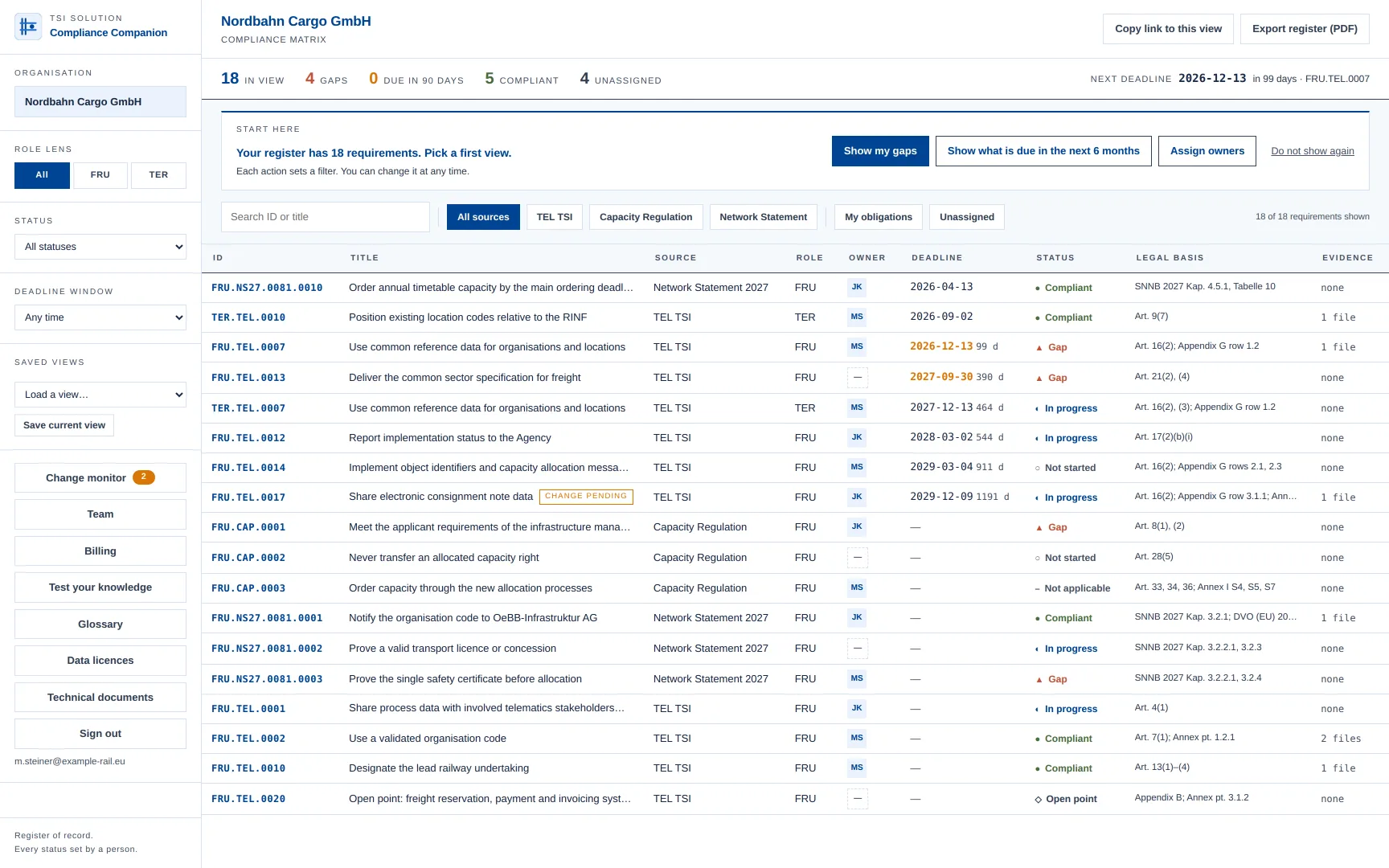
Every requirement that reaches your roles, with the article that requires it and the deadline it must meet. A gap becomes a corrective action with a named owner and a due date, and every status change is a recorded human decision an auditor can trace.

From sign-up to a working register in four steps

  1. 01Create your accountSign up with your work e-mail, or sign in with Google or Microsoft. The first registrant becomes the company admin.
  2. 02Select your companySearch the official ERA Organisation Code Register and select your company.
  3. 03Choose roles and sourcesThe TEL TSI, the Capacity Regulation, MMTIS and the network statements of your networks.
  4. 04Work the matrixAssign owners, turn the suggested steps into corrective actions, attach evidence, and hand the vendor a one-page brief.
The compliance matrix of a sample organisation: gaps, the next deadline, filters and one row per requirement
Adjacent regulations

Where the TEL TSI stops

MMTIS · Del. Reg. (EU) 2017/1926

How the TEL TSI relates to MMTIS

Your TEL TSI data for timetables, tariffs and conditions of carriage counts as the MMTIS format (Annex pts. 4.2.1, 4.3 and 4.4 of EU 2026/253). Other MMTIS duties have their own dates:

  • Observed delays and cancellations: each delay of 60 minutes or more and each cancellation, with the reason when known (MMTIS Art. 4(3)(f))1 December 2025 · passed
  • Dynamic data, comprehensive TEN-T network: disruptions and real-time status, in SIRI, in the TAP TSI specifications or in a fully compatible format (MMTIS Art. 5(1)(b); MMTIS Art. 5(3))1 December 2025 · passed
  • Dynamic data, rest of the network (MMTIS Art. 5(3))1 December 2028
  • Declaration of compliance, when the competent authority asks for it (MMTIS Art. 9(2)(c))On request
Select MMTIS as a source, and the register adds the MMTIS requirements for your role, each with its citation and date.
OPE TSI · Reg. (EU) 2019/773

How the TEL TSI relates to the OPE TSI

TEL TSI governsThe data exchange
OPE TSI governsThe operational duty

OPE point 4.2.3.4.2.1(c) still names the TAF TSI and the TAP TSI. The TEL TSI repealed and replaced both. Under TEL TSI Article 25(2), that reference now reads as a reference to Regulation (EU) 2026/253.

The operational duty is demonstrated through your Safety Management System. The OPE TSI has no interoperability constituents (OPE point 5.2), and none of its requirements needs a separate assessment by a Notified Body (OPE point 6.2.1). This tool does not assess OPE TSI compliance.

Frequently asked questions

TEL TSI questions from passenger RU compliance teams

What does TEL TSI require from passenger railway undertakings?

Under EU 2026/253, a passenger RU grants access to its passenger timetable and conditions of carriage via the national access points, and to its tariffs where a contract requires it. It gives distributors access to availability and reservation data through its attributing system where they have a contractual right. It sends path requests, the passenger train composition and, when necessary, train-ready messages, and it receives the train traffic messages from the infrastructure managers. The lead RU of a service also does the tasks of Art. 13(1).

How is TEL TSI different for passenger RUs compared with freight RUs?

Passenger and freight RUs share the operational messages for paths, train composition, train ready and train traffic. Passenger RUs also have data with no freight equivalent: passenger timetable, tariffs, conditions of carriage, availability and reservations, and on-board passenger information (Annex pt. 4). The timetable, the conditions of carriage and the tariffs go through the national access points, each under its own Creative Commons licence (CC BY-NC-ND 4.0 or CC BY-ND 4.0) or an equivalent or less restrictive licence. The PassengerTrainCompositionMessage also carries seating maps and the location of on-board facilities (pt. 2.5.1(15)).

What are the TEL TSI deadlines for passenger RUs?

They run from 2025 to 2029 (Appendix G). Passenger timetable data: 14 December 2025, already passed. Common reference data, conditions of carriage and security elements for product distribution: 13 December 2026. Passenger travel information during the journey: 12 December 2027. Implementation report to the Agency on train preparation, rail ticketing and rail passenger travel information: 2 March 2028 (Art. 17(2)(b)). Train traffic data and tariff data: 10 December 2028. Path requests and object identifiers: 4 March 2029. Availability and reservations: 10 June 2029. Train composition, train ready and readiness forecast: 9 December 2029. Two milestones of other actors affect you: connection times of the station managers (12 December 2027) and the common reference data for ticketing that the Agency manages (10 December 2028). MMTIS adds its own national access point dates: most fell between 1 December 2019 and 1 December 2025, and dynamic data off the comprehensive TEN-T network is due 1 December 2028.

What are the common interface and the national access points for a passenger RU?

The common interface is a specification, not a central platform. Except for rail ticketing and rail passenger travel information, every API and web UI that a telematics stakeholder deploys must follow ERA-TD-104 (Annex pt. 1.7(1); Appendix C, index [104]). For those two processes, the specifications of Annex Section 4 apply. You exchange the operational messages, such as path requests, train composition and train running, through these APIs and web UIs, and you use public key infrastructure in accordance with ERA-TD-106 (Annex pt. 1.3(b)). The national access points carry the timetable, the conditions of carriage and the tariffs (Art. 6). Availability and reservations go through a direct connection to your attributing system (Art. 6(4)). The ERA Ontology is the semantic model behind the message specifications (Appendix C, index [1]).

Which format do the train traffic messages follow?

Each infrastructure manager sends you the train traffic messages for its network: train running information, train forecasts, delay causes and service interruptions. When your train causes a service disruption, you send the interruption message, or the forecast and delay cause messages, to the infrastructure manager of that network. All four messages follow the ERA Ontology (Appendix C, index [1]), and the infrastructure manager grants access to the data under CC BY-SA 4.0. Under the TEL TSI, SIRI (EN 15531-2:2022) applies to the travel information that you share with the stakeholders who manage connections to other transport modes, including the MMTIS dynamic data (Annex pt. 4.9(d)).

Sources: Art. 5(1)(b), Annex pt. 2.6.1, pt. 2.6.6 and pt. 4.9 of EU 2026/253.

Does this tool assess our OPE TSI compliance?

No. The TEL TSI (Reg. (EU) 2026/253) governs the data exchange: the messages you send and receive for train composition, train readiness, train running, forecasts and interruptions. That is what this tool records. The operational obligations behind those facts come from the OPE TSI (Reg. (EU) 2019/773). For example, OPE point 4.2.3.3.2 requires the railway undertaking to inform the infrastructure manager when a train is ready for access to the network. TEL TSI Annex point 2.5.2 sets out how. The obligation is "deemed to have been fulfilled" without a message in two cases: the train is ready on time according to the working timetable, or Railway Mobile Radio (RMR) or the ETCS L2 "Start of mission" procedure is available as reported in the RINF and mandated by the infrastructure manager of the network of departure through its network statement. When the train is ready late, the railway undertaking must send a TrainReadyMessage. When it is ready early, it may send one. When it is not ready on time, point 2.5.3 also requires a TrainReadyMessage with the status "NotReady". Appendix A.2 of the TEL TSI Annex links train composition (point 2.5.1), train ready (2.5.2), train readiness forecast (2.5.3), train running (2.6.3) and train forecast (2.6.4) to their OPE points. Points 2.6.5 (train delay cause) and 2.6.6 (service disruption) refer to the OPE TSI in their own text. For those messages, OPE creates the duty and the TEL TSI defines the data exchange that implements it. This does not hold for every TEL TSI obligation: the electronic consignment note (point 3.1.1), for example, has no link to the OPE TSI.

The two are also demonstrated in different ways. The OPE TSI is a functional subsystem with no interoperability constituents (OPE point 5.2), and none of its requirements needs a separate assessment by a Notified Body. OPE requirements that refer to structural subsystems and are listed in its interfaces (OPE point 4.3) are assessed under the structural TSIs. Railway undertakings and infrastructure managers demonstrate OPE compliance within their Safety Management System when they apply for a new or amended safety certificate or safety authorisation, and the national safety authority then supervises it (OPE point 6.2.1).

So what you record here shows your readiness to exchange the data the TEL TSI requires. It is not a declaration of compliance: under TEL TSI Article 18, a presumption of compliance comes from a positive result in the web application that ERA provides. It also does not mean that your OPE obligations are met. Those belong in your SMS. Sources: Commission Implementing Regulation (EU) 2019/773 (consolidated version of 31.03.2025), points 4.2.3.3.2, 4.3, 5.2 and 6.2.1; Commission Implementing Regulation (EU) 2026/253, Article 18 and Annex points 2.5.2, 2.5.3 and Appendix A.2.
Next deadline in 61 days

Put your TEL TSI obligations in one register

Create the account, select your company, choose roles and sources. Your register is ready the same day.

Create your account →

TSI Solution GmbH checked this content against the Official Journal text on .