EU 2026/253 · TEL TSI · Freight railway undertakings

TEL TSI compliance for freight railway undertakings

Commission Implementing Regulation (EU) 2026/253 places binding digital obligations on every freight RU operating cross-border services in the EU. Here is exactly what you need to implement - and by when.

No credit card required  ·  Role-traced RU obligations  ·  PDF compliance report included

The outcome

Your answers become an action plan

The readiness check is not a quiz that ends in a score. Every gap it finds becomes a task: the action to take, the article that requires it, and the deadline it must meet. Complete the tasks one by one and you are implementing TEL TSI - with progress you can show an auditor.

See your action plan - free →
Your action plan · sample

Electronic consignment notes (eCN)

EU 2026/253 · Electronic consignment notes · All RUs
Your TEL TSI deadlines

Every deadline for freight railway undertakings - counting down live

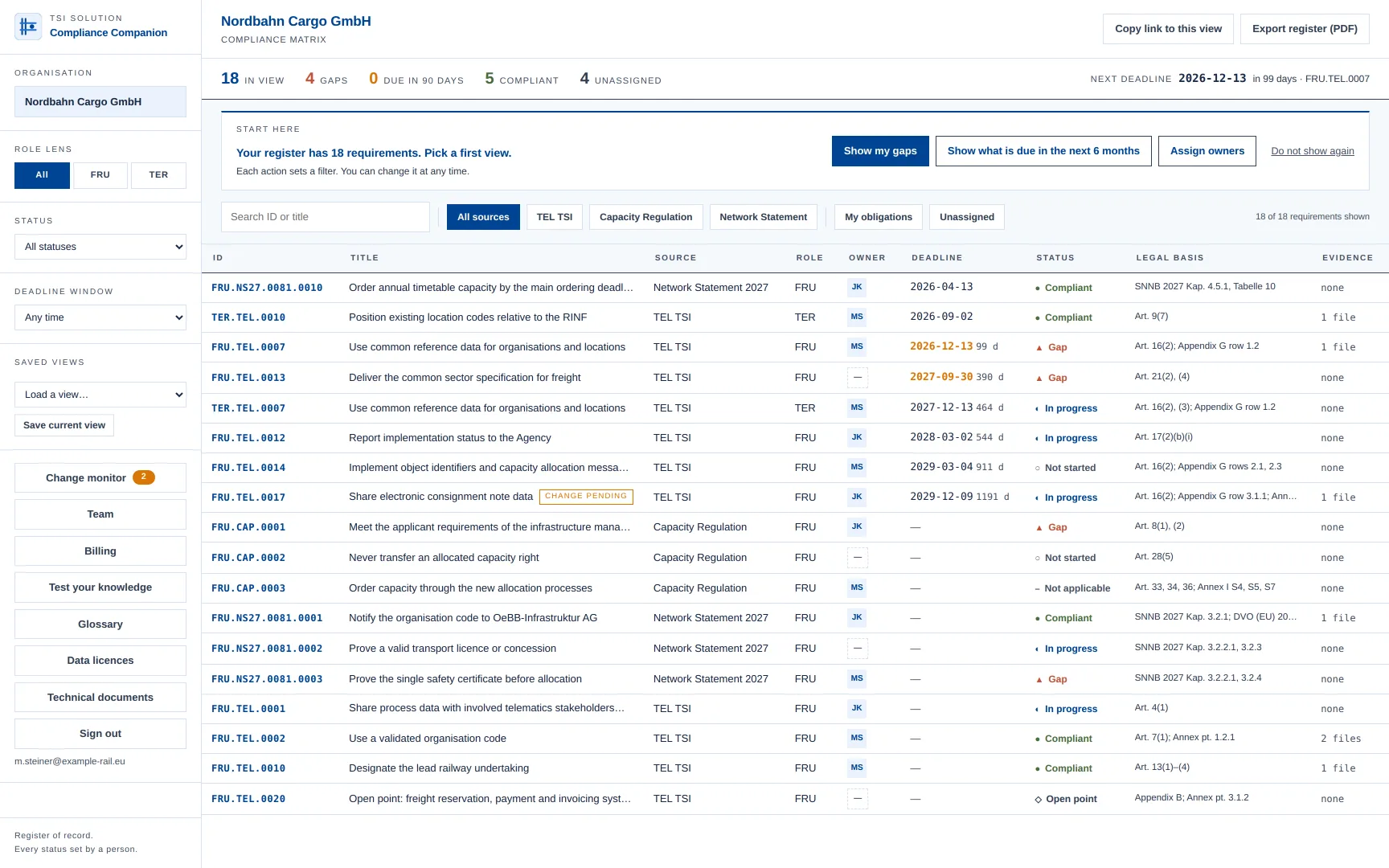
Every EU 2026/253 obligation for freight railway undertakings, plus the ERA milestones, ticking down to the day.

See every TEL TSI obligation and deadline - dated, cited and in plain text →

Freight RU obligations under EU 2026/253

Lead RU vs partner RU - who must do what

TEL TSI obligations depend on your role in the international freight service. Lead RUs carry the most significant implementation burden; partner RUs have more targeted but equally binding requirements.

Lead Railway Undertaking

Lead RU obligations

The lead RU coordinates the end-to-end international freight service and is the primary party responsible for TEL TSI digital workflows with the infrastructure manager and other parties.

  • Submit electronic path requests via the Common Interface (CI)
  • Send train readiness notifications electronically
  • Manage end-to-end electronic consignment notes (eCN) for cross-border movements
  • Coordinate eCN data with partner RUs and freight facility operators
  • Maintain Common Interface connectivity for all mandated workflow categories
  • Accept and process electronic responses from IMs (capacity confirmations, path information)
  • Specify the reference train identifier and the linked ‘TrainID’ - one stable ID describing the planned train and its entire route
  • ! Primary accountability for TEL TSI digital workflow compliance on the service
Partner Railway Undertaking

Partner RU obligations

Partner RUs provide traction or manage specific journey segments. They support the lead RU's workflows and have direct obligations for their own operational segments.

  • Provide electronic train readiness notifications for your segment
  • Exchange eCN data with the lead RU and downstream parties
  • Support Common Interface connectivity for partner-segment data exchange
  • Respond to electronic requests from lead RU via agreed TEL TSI interfaces
  • Ensure your IT systems can receive and forward eCN data in TEL TSI-defined formats
  • Cooperate with lead RU on cross-border path coordination where required
  • Reuse the lead RU's TrainID with your own infrastructure manager for path ordering, capacity allocation and train preparation on your segment
Core TEL TSI obligations for freight RUs

The six digital workflows freight RUs must implement

These are the primary implementation areas for freight railway undertakings under EU 2026/253. Each maps to specific Articles and Annexes of the regulation.

Electronic path requests

Lead RUs must submit capacity requests to infrastructure managers electronically via the Common Interface, replacing paper-based or proprietary bilateral processes. Path requests must conform to TEL TSI-defined data formats and exchange protocols.

EU 2026/253 · Path request obligations · Lead RU

Train readiness notifications

Both lead and partner RUs must send standardised electronic notifications confirming train formation, locomotive assignment, and readiness to depart. These notifications are exchanged with IMs and, where relevant, other RUs in the service chain.

EU 2026/253 · Train readiness · Lead RU + Partner RU

Electronic consignment notes (eCN)

The eCN replaces paper CIM consignment notes for international freight. Lead RUs are responsible for eCN creation, transmission, and end-to-end management. Partner RUs must be capable of receiving, endorsing, and forwarding eCN data through TEL TSI interfaces.

EU 2026/253 · Electronic consignment notes · All RUs

Common Interface (CI) connectivity

All in-scope freight RUs must connect to and operate through the TEL TSI Common Interface - the central data exchange layer mandated by EU 2026/253. Integration must cover path requests, train readiness, and eCN workflows as applicable to your role.

EU 2026/253 · Common Interface · All RUs

Capacity confirmation handling

Lead RUs must be able to receive, interpret, and act on electronic capacity confirmations and path information messages returned by infrastructure managers via the Common Interface. This requires end-to-end IT system support for CI message formats.

EU 2026/253 · Capacity management · Lead RU

Cross-border coordination data

Where your freight service crosses two or more national networks, TEL TSI requires standardised electronic data exchange between RUs, IMs, and facility operators involved in the service. Lead RUs are responsible for coordinating this data flow across all parties.

EU 2026/253 · Cross-border data · Lead RU
TEL TSI readiness check for freight RUs

Know your compliance gap in 30 minutes

The TEL TSI Compliance Companion walks your team through all 13 regulatory chapters - with every question traced to the specific Article or Annex of EU 2026/253.

1

Select your RU role

Tell us whether you are a lead RU, partner RU, or both. The assessment filters obligations to your specific scope - no irrelevant questions.

2

Answer 101 scenario questions

Work through scenario-based questions covering all six core digital workflow areas. Each question cites its exact Article in EU 2026/253.

3

Get your action plan

Receive an instant score, chapter-by-chapter breakdown, and a prioritised action plan to close every gap before your applicable deadlines.

4

Download your PDF report

Export an audit-ready compliance report with every finding traced to regulation - shareable with your board, regulator, or external compliance auditor.

Adjacent regulations

Where the TEL TSI meets eFTI

Building your electronic consignment note (eCN)? You may have come across the eFTI Regulation (EU) 2020/1056 and its 9 July 2027 date. Here is precisely how the two relate - and how they don't.

The asymmetry

From 9 July 2027, competent authorities across the EU must accept freight transport information submitted electronically through a certified eFTI platform - but economic operators, including freight railway undertakings, are not required to submit it electronically. eFTI is an option open to you, not a duty placed on you. (The tell: Art. 16(1) requires the Commission to evaluate, by 21 February 2029, whether to introduce an obligation on economic operators at all.)

The consignment data you are already assembling for the eCN - consignor, consignee, places, goods, weights, dangerous-goods details - overlaps substantially with what eFTI's common data set covers. The two use different technical schemas, so a mapping step would be required; building the eCN does not by itself make you "eFTI-compliant." It is a genuine head start, not a substitute.

  • 30 September 2027 - your Art. 21(4) common sector specification (binding).
  • 9 December 2029 - the freight core bundle, including the eCN itself (binding).
  • 9 July 2027 is not one of them. It does not appear on our deadline board because it is not your obligation.
Adjacent TSIs

How the TEL TSI relates to the OPE TSI

Your train-ready, train-composition and running-information duties connect to a second regulation you may not have mapped yet: the OPE TSI (Commission Implementing Regulation (EU) 2019/773). Here is exactly how the two relate.

The asymmetry

The TEL TSI formally interfaces with the OPE TSI - Appendix A.2 is a dedicated interface table. The OPE TSI does not return the favour: its interface chapter (point 4.3) lists infrastructure, control-command, rolling stock, energy, safety and noise, but no telematics. More strikingly, OPE point 4.2.3.4.2.1(c) still directs infrastructure managers to provide train-position-reporting data "according to Commission Regulation (EU) No 1305/2014 (TAF TSI) and Commission Regulation (EU) No 454/2011 (TAP TSI)" - the two TSIs the TEL TSI repealed and replaced. Read literally today, the OPE TSI's own cross-reference points at instruments that no longer describe the current telematics regime.

  • Train ready for network access - the duty arises in OPE point 4.2.3.3.2; the TEL TSI TrainReadyMessage (Annex pt. 2.5.2) carries it.
  • Train composition - the duty arises in OPE point 4.2.2.5.2; the TEL TSI TrainCompositionMessage (Annex pt. 2.5.1) carries it.
  • Train running, forecast, delay and interruption - the duty arises in OPE point 4.2.3.4; the TEL TSI TrainRunningInformationMessage, TrainRunningForecastMessage and TrainRunningInterruptionMessage (Annex pt. 2.6.3–2.6.6) carry it.

The TEL TSI governs the data exchange. The operational duty itself sits in the OPE TSI and is demonstrated through your Safety Management System when you apply for a safety certificate or safety authorisation - the OPE TSI has no interoperability constituents (OPE point 5.2) and none of its requirements is assessed by a Notified Body (OPE point 6.2.1). This tool does not assess OPE TSI compliance.

Frequently asked questions

TEL TSI questions from freight RU compliance teams

What does TEL TSI require from freight railway undertakings?

Under EU 2026/253, freight RUs must implement electronic path requests, train readiness notifications, and electronic consignment notes (eCN) for cross-border services. Lead RUs are responsible for end-to-end data management and must connect to the Common Interface. Partner RUs have more targeted data exchange obligations but are equally bound by the regulation.

We operate both cross-border and domestic services - what applies to us?

TEL TSI obligations under EU 2026/253 are triggered by your cross-border and international freight operations. Purely domestic services that never connect with cross-border movements are outside the primary scope. However, if your locomotives or wagons operate on international trains at any point - even occasionally - those movements bring you in scope. A readiness check will confirm your exact coverage quickly.

How early should a freight RU start its TEL TSI implementation?

IT integration with the Common Interface, eCN capability development, and staff training for TEL TSI typically require 6–12 months for organisations starting from scratch. With the staggered TEL TSI deadlines running from 15 March 2026 through 2 March 2027 already approaching, freight RUs that have not yet completed a gap assessment should start immediately. Procuring IT solutions and integrating with infrastructure manager systems takes additional time.

What is the Common Interface and how does a freight RU connect to it?

The Common Interface (CI) is the centralised digital exchange layer mandated by TEL TSI through which freight RUs, infrastructure managers, and facility operators exchange structured data. Connection typically requires adapting your train management or ERP system to support CI message formats, or procuring a middleware solution. The technical specifications are defined in the annexes of EU 2026/253.

Does the TEL TSI Compliance Companion support multi-RU group assessments?

Yes. The Team plan supports multiple users and collaborative workspaces, making it well-suited for RU group holding structures or consultancies managing compliance assessments for multiple freight railway undertakings. Enterprise plans include multiple organisation workspaces and custom onboarding.

We're a freight railway undertaking preparing our electronic consignment note (eCN) for the TEL TSI. Does the eFTI Regulation (EU 2020/1056) mean we're now required to go digital too?

No. The eFTI Regulation and the TEL TSI are different obligations pointing in different directions. Under the TEL TSI, the electronic consignment note is a requirement you must meet. Under the eFTI Regulation the obligation runs the other way: from 9 July 2027, competent authorities across the EU must accept freight transport information when it is submitted electronically through a certified eFTI platform - but economic operators, including freight railway undertakings, are not required to submit it electronically. eFTI is an option you can take, not a duty placed on you. If you do choose the electronic route, its conditions then attach: a certified eFTI platform, machine-readable data, and a unique access link. The practical upside: the consignment data you are already building for the TEL TSI eCN - consignor, consignee, places, goods, weights, dangerous-goods details - is substantially the same underlying information eFTI covers, so eCN work is a head start on any future eFTI use. The two systems use different technical formats, so a mapping step is required; building the eCN does not by itself make you "eFTI-compliant." Sources: Regulation (EU) 2020/1056, Arts. 4–5 and Art. 16(1); Commission Implementing Regulation (EU) 2026/253.

Does this tool assess our OPE TSI compliance?

No - and the distinction matters more than it might first appear. The TEL TSI (Reg. (EU) 2026/253) governs the data exchange: the messages you send and receive for train composition, train readiness, train running, forecasts and interruptions. That is what this tool assesses. The operational obligations behind those same facts arise in the OPE TSI (Reg. (EU) 2019/773). For example, it is OPE - not the TEL TSI - that requires the railway undertaking to inform the infrastructure manager when a train is ready for access to the network (OPE point 4.2.3.3.2). The TEL TSI then specifies the TrainReadyMessage that carries that information. A useful way to hold it: OPE creates the duty; the TEL TSI carries the message that implements it. The two are also demonstrated by completely different routes. The OPE TSI is a functional subsystem: it has no interoperability constituents (OPE point 5.2), and none of its requirements is assessed by a Notified Body. Instead, railway undertakings and infrastructure managers demonstrate OPE compliance within their Safety Management System, when applying for a safety certificate or safety authorisation (OPE point 6.2.1). So a strong result here means you are ready to exchange the data the TEL TSI requires. It does not mean - and cannot mean - that your OPE obligations are met. Those belong in your SMS. Sources: Commission Implementing Regulation (EU) 2019/773 (consolidated), points 4.2.3.3.2, 5.2, 6.2.1; Commission Implementing Regulation (EU) 2026/253.

Check your freight RU's TEL TSI readiness - free

30 minutes, 101 questions, role-filtered for lead RU or partner RU. Get your action plan and PDF report today.

Start free - no card required

Questions?

TSI Solution GmbH checked this content against the Official Journal text on .