TEL TSI compliance for terminal operators
Regulation (EU) 2026/253 makes the operators of TEN-T multimodal rail freight terminals telematics stakeholders. Here is what your terminal must implement, and by when.
14-day free trialSelf-service registrationRegister ready the same dayIs your terminal in scope?
In the modelled register: 21 from the TEL TSI and 2 from the Capacity Regulation. 11 carry a modelled deadline. See the TEL TSI deadlines for all roles.
- In scope when all three hold
- You operate a service facility listed in point (2)(b), (c), (d) or (g) of Annex II to Directive 2012/34/EU
- The facility is connected to the TEN-T
- It is a multimodal freight terminal identified under Article 36 of Regulation (EU) 2024/1679
The definition is in Art. 3(8). Operators of other service facilities may apply the TEL TSI voluntarily (Art. 16(4)).
Your terminal is a telematics stakeholder
The TEL TSI treats your terminal as a data node in each rail transport service. Your obligations fall into two groups.
Operational data exchange
5 dutiesOn the sections operated on your network according to a path, you send the train traffic messages to the railway undertakings, unless a railway undertaking does not require them and you agree this bilaterally (Annex pt. 2.6.1(3)).
- Send the TrainRunningInformationMessage when a train departs from or arrives at a reporting point on your sections
- Receive the TrainCompositionMessage from the freight RU whose intermodal train arrives to be unloaded
- Send the TrainRunningForecastMessage, TrainDelayCauseMessage and TrainRunningInterruptionMessage for delays and disruptions on your sections
- Confirm train closure to the lead RU with a TrainRunningInformationMessage when you load or unload a set of wagons in intermodal transport; mandatory for single wagonload services
- Receive the disruption messages that a railway undertaking sends when its train causes a disruption on your network, and send updated information where relevant
Reference data & foundations
6 dutiesBefore any message can flow, your terminal must be identifiable and must use a compliant telematics application.
- Hold an organisation code assigned by the Agency for the terminal, and use your partners' codes from the common central repository
- Request location codes from the Agency, and position your existing location codes relative to the RINF by 2 September 2026
- Use the ILU reference data that the ILU keepers share through their databases
- Share data through an API or web UI, your own or one used jointly with other stakeholders, and make it comply with the common interface specification ERA-TD-104
- Apply the cybersecurity measures of Annex pt. 1.3, including PKI in accordance with ERA-TD-106, and the ERA Ontology semantics
- Grant access to the historic record of train related data through a common Union web UI, for at least 12 months
Every Appendix G milestone, plus 12 months
Under Art. 16(3), operators of rail freight service facilities get an additional transitional period of 12 months for the Appendix G milestones. The board reads the 12 months literally from each milestone. Whether they run to the December timetable change instead is still an open question.
Not shifted: RINF position of location codes assigned before entry into force, due 2 September 2026 (Art. 9(7)); Common sector specification for the common Union API and web UI (terminal operators), due 30 September 2027 (Art. 21(4)); Implementation report to the Agency, due 2 March 2028 (Art. 17(2)(b)(ii)).
Your obligations become a working register
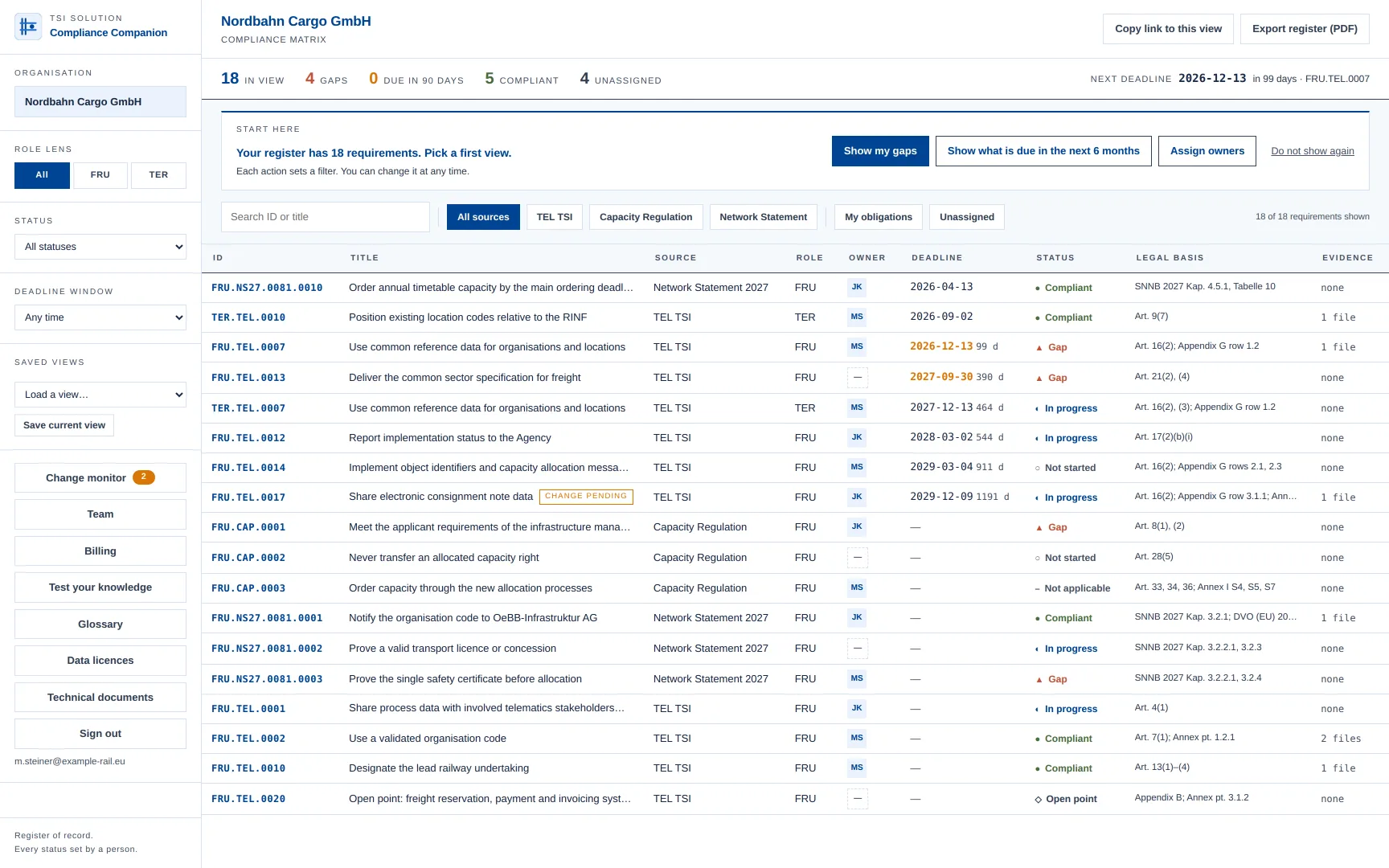
Every requirement that reaches your roles, with the article that requires it and the deadline it must meet. A gap becomes a corrective action with a named owner and a due date, and every status change is a recorded human decision an auditor can trace.
From sign-up to a working register in four steps
- 01Create your accountSign up with your work e-mail, or sign in with Google or Microsoft. The first registrant becomes the company admin.
- 02Select your companySearch the official ERA Organisation Code Register and select your company.
- 03Choose roles and sourcesThe TEL TSI, the Capacity Regulation and the network statements of your networks.
- 04Work the matrixAssign owners, turn the suggested steps into corrective actions, attach evidence, and hand the vendor a one-page brief.
TEL TSI questions from terminal operator teams
Is my rail freight terminal in scope of TEL TSI?
Yes, if you operate a rail freight service facility within the definition of Art. 3(8). It covers operators of the service facilities listed in point (2)(b), (c), (d) and (g) of Annex II to Directive 2012/34/EU that are connected to the TEN-T, limited to the multimodal freight terminals identified under Article 36 of Regulation (EU) 2024/1679. The TEL TSI applies to the Union rail system (Art. 2(2)), so it covers domestic and cross-border traffic alike. Operators of other service facilities may apply it voluntarily (Art. 16(4)).
What messages does a terminal actually have to handle?
On your own sections, you send the train traffic messages to the railway undertakings: running information, forecasts, delay causes and interruptions (Annex pt. 2.6.1(3); pt. 2.6.3 to 2.6.6). The exception is where a railway undertaking does not require them and you agree this bilaterally. You receive the TrainCompositionMessage for intermodal trains that arrive to be unloaded (pt. 2.5.1(3)), and the disruption messages that a railway undertaking sends when its train causes a disruption. Where relevant, you then send updated information (pt. 2.6.6(3)). In intermodal transport, you confirm train closure to the lead RU when you load or unload a set of wagons (pt. 3.2.1.3(3)). Read literally, that duty is mandatory only for single wagonload services (pt. 3.2(1), 3.2.1.2(5)). Each exchange goes through an API or web UI, your own or a jointly used one, which follows the common interface specification (pt. 1.7(1)).
When do the TEL TSI deadlines fall for a terminal operator?
Under Article 16(3), operators of rail freight service facilities get an additional transitional period of 12 months for the Appendix G milestones. The position of existing location codes relative to the RINF was due 2 September 2026 (Art. 9(7)). Your common sector specification is due 30 September 2027 (Art. 21(4)). Common reference data for organisations and locations is due 13 December 2027, and the implementation report to the Agency 2 March 2028 (Art. 17(2)(b)(ii)). Where your terminal acts as an applicant for capacity, object identifiers and capacity allocation messaging are due 4 March 2030. Full deployment of your train traffic and train composition messaging is due 9 December 2030. The board reads the 12 months literally from each milestone. Whether they run to the December timetable change instead is still an open question.
How does a terminal's role connect to RUs and IMs?
Your terminal works between the railway undertakings and the infrastructure manager. On your own sections, you send the train traffic messages to the railway undertakings, as the infrastructure manager does on its network, unless a railway undertaking does not require them and you agree this bilaterally (Annex pt. 2.6.1(3)). The freight RU that operates an arriving intermodal train sends you its composition (pt. 2.5.1(3)), and you confirm train closure to the lead RU (pt. 3.2.1.3(3)). For capacity in your facility, the messages of points 2.3.2 to 2.3.9 go between the applicant and the infrastructure manager or the allocation body of the connected network (pt. 2.3.1(3)).
Does the TEL TSI Compliance Companion cover terminal workflows?
Yes. The register carries the TEL TSI rows for terminal operators, each cited to its Article or Annex point of EU 2026/253. They cover data sharing and access to traffic data (Art. 4(1); Art. 5(1)), and organisation and location codes (Art. 7; Art. 9(7)). They also cover cybersecurity, semantics and data quality (Art. 7; Art. 10), and compliant telematics applications and the common Union API (Art. 14(5)(b); Art. 16). Further rows cover the check of your messages in the Agency's web application (Art. 18(2)), the implementation report (Art. 17(2)(b)(ii)), the common sector specification (Art. 21(3), (4)) and the Appendix G deployment milestone. 2 rows come from the Capacity Regulation (EU) 2026/1184. Every row states how compliance is proven, when it counts as done, the suggested evidence and the suggested steps. One plan covers every user in the organisation; an operator with several facilities under one company works them in one account.
Put your TEL TSI obligations in one register
Create the account, select your company, choose roles and sources. Your register is ready the same day.
Create your account →TSI Solution GmbH checked this content against the Official Journal text on .