TEL TSI compliance for passenger railway undertakings
Commission Implementing Regulation (EU) 2026/253 places binding digital obligations on every passenger RU operating services in the EU - from timetable and tariff data to train composition and ticketing. Here is exactly what you need to implement - and by when.
No credit card required · Role-traced RU obligations · PDF compliance report included
Your answers become an action plan
The readiness check is not a quiz that ends in a score. Every gap it finds becomes a task: the action to take, the article that requires it, and the deadline it must meet. Complete the tasks one by one and you are implementing TEL TSI - with progress you can show an auditor.
See your action plan - free →Passenger timetable data
Every deadline for passenger railway undertakings - counting down live
Every EU 2026/253 obligation for passenger railway undertakings, plus the ERA milestones, ticking down to the day.
See every TEL TSI obligation and deadline - dated, cited and in plain text →
Lead RU vs partner RU - who must do what
On an international passenger service, TEL TSI obligations depend on your role. The lead RU coordinates the end-to-end service and timetable; the partner RU operates its own leg with targeted but equally binding requirements.
Lead RU obligations
The lead RU coordinates the end-to-end international passenger service across both infrastructure managers and is the primary party responsible for publishing complete service data and running the TEL TSI operational message flows.
- ✓ Publish and aggregate the complete passenger timetable to NAPs in NeTEx format
- ✓ Order and manage train paths via the Common Interface across both IM networks
- ✓ Send the PassengerTrainCompositionMessage - with accessibility data - before departure
- ✓ Send the TrainReadyMessage - including the NotReady status that conveys the readiness forecast
- ✓ Share real-time train running and forecast data (SIRI) with IMs and station managers
- ✓ Publish conditions of carriage, tariff and ticketing data to NAPs under the correct licences
- ✓ Specify the reference train identifier and the linked ‘TrainID’ - one stable ID describing the planned train and its entire route
- ! Primary accountability for end-to-end passenger data compliance on the service
Partner RU obligations
Partner RUs operate a specific leg of the international service. They publish and exchange data for their own segment and coordinate with the lead RU on the through service.
- ✓ Publish timetable, composition and running data for your own leg
- ✓ Coordinate with the lead RU on through-service timetable aggregation
- ✓ Exchange path-request and train-composition messages for your segment via the CI
- ✓ Provide real-time running and forecast data (SIRI) for your leg to the relevant IM
- ✓ Support connection-time and station information at the interchange station
- ✓ Align your PKI certificates and schema versions with the shared service
- ✓ Reuse the lead RU's TrainID with your own infrastructure manager for path ordering, capacity allocation and train composition on your leg
The six workflows passenger RUs must implement
These are the primary implementation areas for passenger railway undertakings under EU 2026/253. Each maps to specific Articles and Annex points of the regulation.
Passenger timetable data
Complete, accurate passenger timetable data must be published to National Access Points (NAPs) in NeTEx format, under the CC BY-NC-ND 4.0 licence. Lead RUs aggregate the through-service timetable. This is the earliest obligation - the deadline of 14 December 2025 has already passed.
Capacity & path ordering
Paths must be ordered and managed via the Common Interface using the TEL TSI capacity message sequence - PathRequestMessage, ReceiptConfirmation and the path lifecycle messages - coordinated across every infrastructure manager on the route.
Passenger train composition
The PassengerTrainCompositionMessage must reach the infrastructure manager before departure. Beyond the freight equivalent it carries accessibility data and quiet-route parameters, and must meet a 100% nominal accuracy standard linked to the accessibility information published in the timetable.
Train ready & readiness forecast
TEL TSI requires the TrainReadyMessage to signal readiness to access the network. When the train will not be ready on time, that same message - bearing the NotReady status - conveys a readiness forecast with a delay estimate and cause (Annex pt. 2.5.3). Your organisation must define when it is sent and the internal authorisation process behind it.
Real-time running & forecast (SIRI)
Real-time passenger train running and forecast data flows from you to the infrastructure managers and on to station managers and on-board information systems. The mandatory format is SIRI - not NeTEx - covering delay reporting, service interruption and the station information chain under a BY-SA licence.
Conditions of carriage, tariff & ticketing
Conditions of carriage (general, luggage, bicycle, car, PRM assistance, station accessibility), tariff data and ticketing/availability data must be published to NAPs in NeTEx format and shared with distributors and retailers - each under its specific Creative Commons or EUPL licence.
Know your compliance gap in 30 minutes
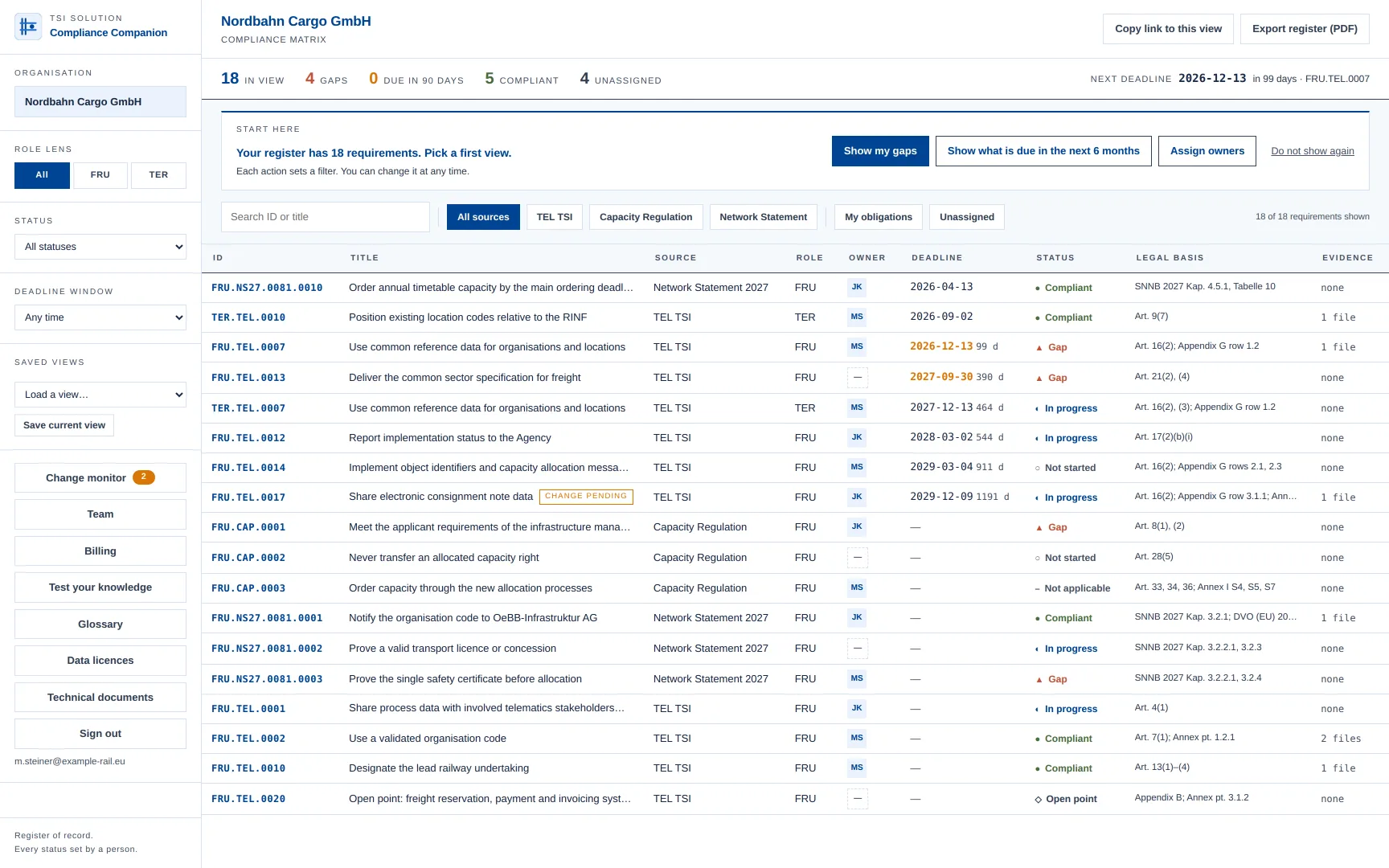
The TEL TSI Compliance Companion walks your team through every passenger RU obligation - with each question traced to the specific Article or Annex point of EU 2026/253.
Select your RU role
Tell us whether you are a lead RU, partner RU, or both, and your service configuration. The assessment filters obligations to your specific scope.
Answer the scenario questions
Work through scenario-based questions covering timetable, capacity, composition, running data, ticketing and licensing. Each cites its exact reference in EU 2026/253.
Get your action plan
Receive an instant score, chapter-by-chapter breakdown, and a deadline-prioritised action plan - with overdue obligations flagged first.
Download your PDF report
Export an audit-ready compliance report with every finding traced to regulation - shareable with your board, regulator, or external compliance auditor.
How the TEL TSI relates to the OPE TSI
Your train-ready, train-composition and running-information duties connect to a second regulation you may not have mapped yet: the OPE TSI (Commission Implementing Regulation (EU) 2019/773). Here is exactly how the two relate.
The TEL TSI formally interfaces with the OPE TSI - Appendix A.2 is a dedicated interface table. The OPE TSI does not return the favour: its interface chapter (point 4.3) lists infrastructure, control-command, rolling stock, energy, safety and noise, but no telematics. More strikingly, OPE point 4.2.3.4.2.1(c) still directs infrastructure managers to provide train-position-reporting data "according to Commission Regulation (EU) No 1305/2014 (TAF TSI) and Commission Regulation (EU) No 454/2011 (TAP TSI)" - the two TSIs the TEL TSI repealed and replaced. Read literally today, the OPE TSI's own cross-reference points at instruments that no longer describe the current telematics regime.
- Train ready for network access - the duty arises in OPE point 4.2.3.3.2; the TEL TSI TrainReadyMessage (Annex pt. 2.5.2) and readiness forecast (pt. 2.5.3) carry it.
- Train composition - the duty arises in OPE point 4.2.2.5.2; the TEL TSI PassengerTrainCompositionMessage (Annex pt. 2.5.1) carries it.
- Train running, forecast and delay - the duty arises in OPE point 4.2.3.4; the TEL TSI TrainRunningInformationMessage, TrainRunningForecastMessage and delay-cause data (Annex pt. 2.6.3–2.6.5) carry it.
The TEL TSI governs the data exchange. The operational duty itself sits in the OPE TSI and is demonstrated through your Safety Management System when you apply for a safety certificate or safety authorisation - the OPE TSI has no interoperability constituents (OPE point 5.2) and none of its requirements is assessed by a Notified Body (OPE point 6.2.1). This tool does not assess OPE TSI compliance.
Full analysis: The OPE TSI still points to TAF and TAP. Here's what replaced them. →
Quick answer: Does this tool assess our OPE TSI compliance? →
TEL TSI questions from passenger RU compliance teams
What does TEL TSI require from passenger railway undertakings?
Under EU 2026/253, passenger RUs must publish passenger timetable, tariff, ticketing and conditions-of-carriage data to National Access Points (NAPs) in NeTEx format, exchange operational messages - path requests, passenger train composition, train ready and readiness forecast - via the Common Interface, and share real-time running and forecast data in SIRI format. Lead RUs coordinate the end-to-end international service; partner RUs handle their own leg but are equally bound.
How is TEL TSI different for passenger RUs compared with freight RUs?
Passenger RUs share the Common Interface and core operational messaging with freight, but TEL TSI adds a second mandatory channel - NAPs - for static and commercial data, plus obligations with no freight equivalent: passenger timetable in NeTEx, tariff, ticketing and conditions of carriage, accessibility (PRM) and station information, and four Creative Commons licences (plus EUPL) governing downstream use. Passenger train composition must also meet a 100% nominal accuracy standard and carry accessibility data.
What are the TEL TSI deadlines for passenger RUs?
They are staggered from 2025 to 2029. Passenger timetable data was due 14 December 2025 (already overdue). Reference data, conditions of carriage, accessibility (ERSAD) and ticket formats are due 13 December 2026; connection times and passenger information in stations and on-board, 12 December 2027; the Art. 17(2)(b) compliance report to ERA on train preparation, rail ticketing and rail passenger travel information, 2 March 2028; real-time running & forecast, ticketing reference data and tariff, 10 December 2028; availability and reservations, 10 June 2029; and passenger train composition, train ready and readiness forecast, 9 December 2029.
What are the Common Interface and National Access Points for a passenger RU?
Passenger TEL TSI uses two mandatory channels. The Common Interface (CI) carries operational messages - path requests, train composition, train running - secured with a two-level PKI (ORCAC and ONCC certificates via ERA). National Access Points (NAPs) carry static and commercial data - timetable, tariff, ticketing, conditions of carriage - in NeTEx format. The ERA Ontology is the semantic master layer from which the schemas are derived.
Does the tool support passenger RU group assessments?
Yes. The passenger railway undertaking assessment is a first-class module in the tool. The Team plan supports multiple users and shared workspaces - well-suited for RU group structures or consultancies managing several passenger railway undertakings. Enterprise plans add multiple organisation workspaces and custom onboarding.
Does this tool assess our OPE TSI compliance?
No - and the distinction matters more than it might first appear. The TEL TSI (Reg. (EU) 2026/253) governs the data exchange: the messages you send and receive for train composition, train readiness, train running, forecasts and interruptions. That is what this tool assesses. The operational obligations behind those same facts arise in the OPE TSI (Reg. (EU) 2019/773). For example, it is OPE - not the TEL TSI - that requires the railway undertaking to inform the infrastructure manager when a train is ready for access to the network (OPE point 4.2.3.3.2). The TEL TSI then specifies the TrainReadyMessage that carries that information. A useful way to hold it: OPE creates the duty; the TEL TSI carries the message that implements it. The two are also demonstrated by completely different routes. The OPE TSI is a functional subsystem: it has no interoperability constituents (OPE point 5.2), and none of its requirements is assessed by a Notified Body. Instead, railway undertakings and infrastructure managers demonstrate OPE compliance within their Safety Management System, when applying for a safety certificate or safety authorisation (OPE point 6.2.1). So a strong result here means you are ready to exchange the data the TEL TSI requires. It does not mean - and cannot mean - that your OPE obligations are met. Those belong in your SMS. Sources: Commission Implementing Regulation (EU) 2019/773 (consolidated), points 4.2.3.3.2, 5.2, 6.2.1; Commission Implementing Regulation (EU) 2026/253.
Check your passenger RU's TEL TSI readiness - free
30 minutes, role-filtered for lead RU or partner RU. Get your action plan and PDF report today.
Start free - no card requiredQuestions?
TSI Solution GmbH checked this content against the Official Journal text on .